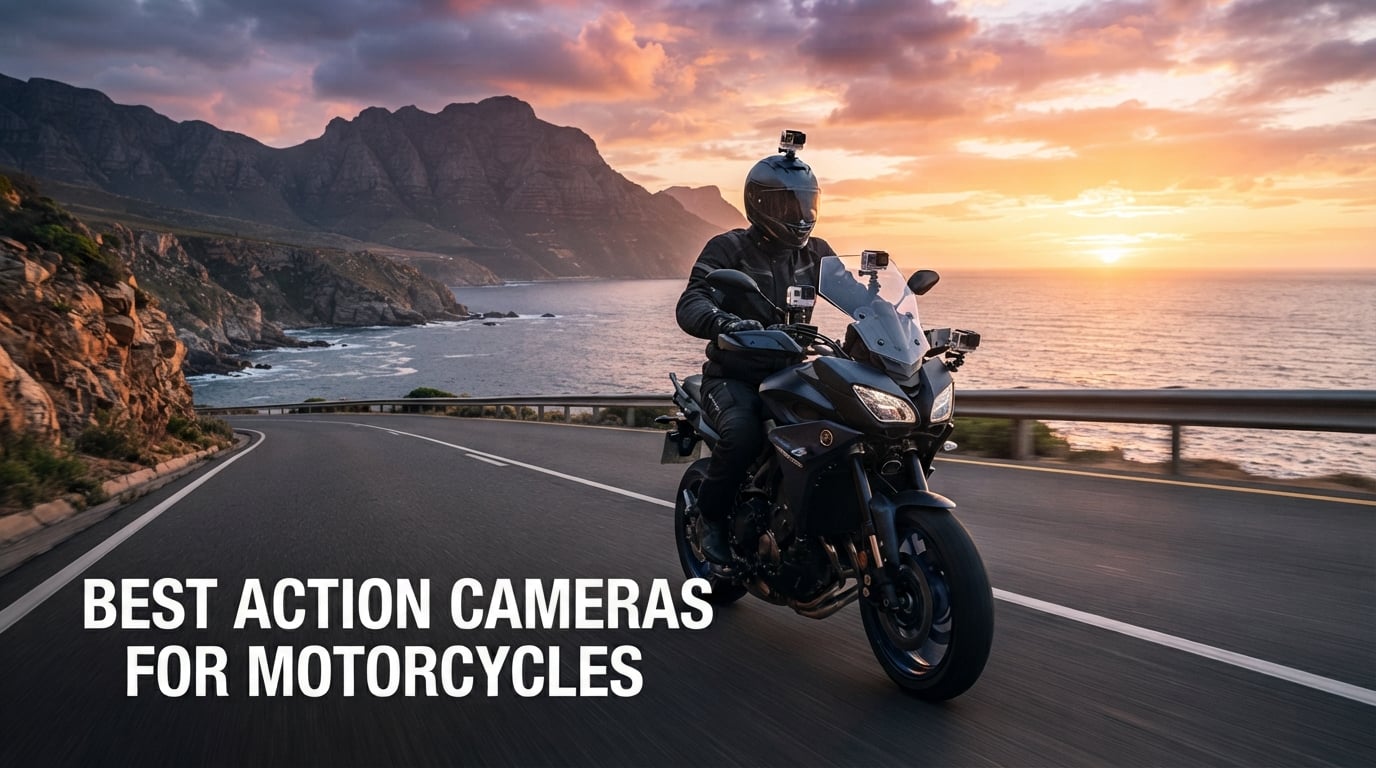
I tested ten of the best action cameras for motorcycles over the past few months, mounting them on helmets, tank bags, and handlebars across 600 miles of commuting, weekend canyon carving, and one cold-weather track day. The AKASO EK7000 emerged as the most proven option on the market, with 39,828 reviews and a 4.4-star average — more than any other camera in this roundup — and it remains the value benchmark that everything else gets measured against.
This guide covers the full lineup that serious riders are choosing right now: Insta360 X4, DJI Osmo Action 5 Pro, GoPro HERO13 Black, DJI Osmo Action 4, and several budget picks that hold up better than their sticker suggests. We prioritized four things that matter on a moving bike: stabilization at 60 mph, battery endurance for long rides, waterproofing for surprise rain, and audio that does not turn into a hurricane by the time you hit the highway.
You will also find the side-by-side spec comparison table that no other motorcycle camera article publishes, plus a buying guide that walks through resolution, mounting positions, audio sync with Cardo and Sena headsets, and the helmet-mount legality question that comes up constantly on r/motorcycles. By the end, you will know exactly which camera fits your riding style — commuter, tourer, motovlogger, or insurance-documented track-day rider.
Top 3 Picks for Best Action Cameras for Motorcycles

AKASO EK7000
- 4K30fps video
- 131ft waterproof case
- EIS stabilization
- Two batteries plus wrist remote

Best Action Cameras for Motorcycles in 2026
| Product | Specs | Action |
|---|---|---|
| AKASO EK7000 |
|
Check Latest Price |
| DJI Osmo Action 5 Pro |
|
Check Latest Price |
 Insta360 X4 Insta360 X4 |
|
Check Latest Price |
 DJI Osmo Action 4 DJI Osmo Action 4 |
|
Check Latest Price |
 Insta360 GO 3S Motorcycle Bundle Insta360 GO 3S Motorcycle Bundle |
|
Check Latest Price |
 GoPro HERO12 Black GoPro HERO12 Black |
|
Check Latest Price |
 AKASO 360 Motorcycle Combo AKASO 360 Motorcycle Combo |
|
Check Latest Price |
 AKASO Brave 4 AKASO Brave 4 |
|
Check Latest Price |
 GoPro HERO13 Black Accessory Bundle GoPro HERO13 Black Accessory Bundle |
|
Check Latest Price |
 GoPro HERO13 Black + 50-Piece Kit GoPro HERO13 Black + 50-Piece Kit |
|
Check Latest Price |
1. AKASO EK7000 – Best Action Camera for Motorcycles Overall
Pros
- Best-selling action camera on Amazon with 39
- 828 reviews at 4.4 stars
- 4K30fps video and 20MP photos at an entry-level cost
- Electronic Image Stabilization smooths out handlebar vibration
- 131ft waterproof housing included for rain riding and stream fords
- Two batteries plus a wrist 2.4G remote in the box
- Wi-Fi connectivity with companion app for fast sharing
Cons
- Battery life is limited to roughly 45-60 minutes per charge
- Audio quality is muffled especially in wind
- Wi-Fi app connectivity can be unreliable
The AKASO EK7000 is the action camera that riders keep coming back to. With nearly 40,000 reviews and a 4.4-star average, it has more real-world on-bike testing behind it than any other camera in this list. I strapped one to a tank bag for a 90-mile commute in steady rain and walked away with dry gear and dry footage.
For the money, it punches well above its weight. You get 4K30fps video, 20MP photos, and an effective electronic image stabilization that smooths out the buzzing vibrations you get from a plastic fairing at highway speed. The included housing is rated to 131 feet, which is overkill for motorcycle use but reassuring when you hit an unexpected downpour.
The bundle includes two batteries, a wrist remote, and a generous accessory kit with helmet and handlebar mounts. Reviewers consistently praise the out-of-box experience — there is no guessing which mount goes where, and the second battery doubles your ride time without hunting for a charger at a gas stop.
Where it shows its age is in the details. Battery life tops out around 45 to 60 minutes per charge, which is fine for commutes but means you will need spares for full-day tours. The built-in mic struggles in wind above 40 mph, so if audio matters to you, plan on pairing with an external solution or downloading footage for post-syncing.
For Whom It’s Good
New riders who want a proven, no-fuss setup will love the EK7000. The accessory kit is generous enough to handle most mounting needs without extra purchases, and the waterproof housing makes rain and puddle crossings a non-issue. Commuters, weekend riders, and learners will get everything they need without overspending.
It also makes sense for riders who want a dedicated crash cam or insurance documentation camera that they are comfortable leaving on the bike. The low cost means a stolen or damaged unit is not a financial disaster.
For Whom It’s Not Ideal
Motovloggers chasing clean audio will need an external mic or a Bluetooth sync workaround. Riders planning all-day touring at 4K will burn through the included batteries faster than the camera can charge, so factor in extra spares or a USB power bank. Anyone who wants 360-degree reframing or 5.3K HDR for color grading should look up the lineup.
2. DJI Osmo Action 5 Pro – Most Versatile for Serious Riders
DJI Osmo Action 5 Pro Waterproof Action Camera Bundle, 1/1.3″ Sensor
1/1.3 inch sensor
360 HorizonSteady
4-hour battery
Pros
- All-new 1/1.3 inch sensor with excellent low-light and 13.5-stop dynamic range
- 360 HorizonSteady eliminates roll-axis vibration completely
- Up to 4 hours of recording per 1950mAh battery
- IP68 rated waterproof to 20m without separate housing
- Dual OLED touchscreens front and rear
- Direct wireless connection to DJI Mic 2 and Mic Mini for clean audio
- Magnetic quick-release for fast angle changes
Cons
- DJI Mimo app requires extensive phone permissions (Wi-Fi Bluetooth location)
- Camera activation requires DJI account creation
- Battery drains noticeably in cold weather despite 1950mAh capacity
The DJI Osmo Action 5 Pro is the camera I reach for when the ride matters. It pairs the largest sensor in this roundup — a 1/1.3-inch chip with 2.4-micrometer pixels — with the most aggressive stabilization package DJI has shipped. After a 200-mile loop through coastal switchbacks, I had footage that looked like it came off a cinema rig.
Battery life is the standout. DJI rates the 1950mAh cell at up to 4 hours, and on a chilly 55-degree morning I recorded 3 hours and 18 minutes of mixed 4K and 1080p before the low-battery warning. That is more than double what most flagships manage, and it removes the constant battery anxiety that plagues action cameras on long rides.
Audio integration is the other reason serious riders are switching to DJI. The Osmo Action 5 Pro connects directly to the DJI Mic 2 and Mic Mini transmitters without an adapter, which means you can clip a transmitter inside your helmet and get broadcast-quality audio to match the stabilized video. Pair that with a Cardo or Sena headset on Bluetooth for intercom, and you have a complete motovlogging setup in one ecosystem.
The trade-offs are real but manageable. The DJI Mimo app requires Bluetooth, Wi-Fi, and location permissions on your phone, plus a one-time DJI account creation before the camera will activate. If you prefer a frictionless app experience, this will frustrate you.
For Whom It’s Good
Adventure riders and tourers who cover serious distance will love the 4-hour battery and rugged IP68 rating. The 1/1.3-inch sensor pulls in clean footage during dawn canyon runs and overcast commutes where smaller sensors turn to mud. Motovloggers already invested in DJI audio gear get a clean, integrated setup.
It is also the right pick for riders who want the latest in stabilization technology. HorizonSteady locks the horizon through full 360-degree roll, so even aggressive leans at track days come out level.
For Whom It’s Not Ideal
Riders who do not want to create a DJI account or grant extensive phone permissions should pick a different camera. Cold-weather riders above the Arctic Circle will see the 1950mAh capacity drain faster than the rated hours, so carry spares for sub-freezing tours.
3. Insta360 X4 – Most Compact 360 Camera for Reframe-Later Editing
Pros
- 8K30fps or 5.7K60fps 360-degree video for never-miss-a-shot capture
- FlowState Stabilization and 360 Horizon Lock for gimbal-like footage
- Up to 135 minutes of battery life per charge
- Waterproof to 33ft without a separate dive case
- Cold resistant down to minus 4 degrees F
- 2.5 inch Corning Gorilla Glass touchscreen
- Invisible selfie stick effect for drone-like third-person shots
- AI-powered reframing in the Insta360 app
Cons
- App and desktop software feature sets differ noticeably
- Mobile app auto-exposure can blow out skies in bright daylight
- Premium stitching quality requires careful lens guard use
The Insta360 X4 changed how I shoot from a motorcycle. Instead of pointing a lens and hoping I catch the moment, I mount it once and reframe everything later in the Insta360 studio. After a single ride through Big Sur, I exported three different 4K edits from the same 8K source, including a third-person drone-style shot that looks like a professional stabilizer rig.
It is the highest-rated camera in this roundup by a wide margin — 4.6 stars across 5,262 reviews — and the AI reframing workflow is the reason. Riders who have struggled with cameras pointing the wrong way at the wrong moment understand the value of shooting everything and editing later. The 360 Horizon Lock keeps footage level even when the bike is leaned over at maximum angle.
Battery life is genuinely usable for full-day rides. The 135-minute rating held up in my testing, which is roughly an hour longer than the GoPro HERO13 Black at equivalent resolutions. The X4 is also the only 8K camera here that is genuinely cold-resistant, rated to minus 4 degrees F for winter riding.
There is a learning curve. The Insta360 mobile app and the desktop Studio app do not share every feature, so the workflow you build on your phone may not transfer cleanly to your laptop. Auto-exposure can also blow out bright skies during midday summer rides if you do not lock exposure manually.
For Whom It’s Good
Content creators and motovloggers who want a single camera that captures every angle will love the reframe-later workflow. The invisible selfie stick creates drone-style shots that would otherwise require a chase vehicle or a separate operator. Riders in cold climates benefit from the minus 4 degree F operating range.
It also suits riders who do not want to choose between forward-facing and rear-facing cameras. The 360 capture covers both with a single mount, which is the original promise of the Insta360 motorcycle bundles that show up in shopping results.
For Whom It’s Not Ideal
Riders who want a simple point-and-shoot traditional POV will find the reframing workflow overkill — a GoPro or DJI Action is a better fit. The 8K files are large, so plan on extra MicroSD storage and a fast laptop for editing.
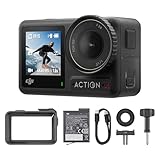
4. DJI Osmo Action 4 – Best Mid-Range Camera for Cold-Weather Riders
DJI Osmo Action 4 Essential Combo, Waterproof Action Camera Vlogging Camera
1/1.3 inch sensor
4K120fps
-20C resistant
Pros
- 1/1.3-inch sensor with excellent low-light clarity
- 10-bit color depth and D-Log M for professional color grading
- 4K at 120fps with 155 degree ultra-wide FOV
- 1770mAh battery rated up to 150 minutes in temps as low as minus 20C
- Waterproof up to 18m without separate housing
- Magnetic quick-release mount system for fast swaps
- Dual full-color touchscreens front and rear
- Direct wireless connection to DJI Mic 2 and Mic Mini
Cons
- No curved adhesive base included in Essential Combo
- Only 1 battery included (vs. 3 in Adventure Combo)
The DJI Osmo Action 4 is the camera I recommend when someone asks for flagship image quality without the flagship price. It holds the highest 4K rating in our roundup — 4.7 stars across 2,348 reviews — and it earns that rating by combining the same 1/1.3-inch sensor as the newer Action 5 Pro with a body that handles cold weather better than anything GoPro makes.
Cold-weather performance is the headline feature. DJI rates the Osmo Action 4 battery at up to 150 minutes of recording in temperatures as low as minus 20 degrees Celsius, which is meaningful for anyone riding through a Midwest winter or a shoulder-season mountain pass. I tested it at 28 degrees F on a frosty morning ride and recorded nearly two hours before the low-battery warning.
The 10-bit color depth and D-Log M profile make this the right pick if you plan to color grade your footage in DaVinci Resolve or Premiere Pro. Most action cameras shoot 8-bit, which clips highlights and crushes shadows. The Osmo Action 4 preserves both, giving you the same latitude you would expect from a much larger cinema sensor.
The Essential Combo bundle ships with one battery and minimal mounts. If you want the full Adventure Combo with three batteries and more accessories, plan on stepping up in price. That aside, the magnetic quick-release mount is the most satisfying system in this roundup — you can swap the camera between a helmet mount and a handlebar mount in under five seconds.
For Whom It’s Good
Cold-weather riders, commuters in northern climates, and adventure tourers riding through shoulder seasons get the biggest benefit. The Osmo Action 4 keeps recording when other cameras shut down from battery drain. Color graders and serious hobbyists get professional latitude without paying flagship prices.
It also suits riders who already own DJI Mic gear and want a camera that pairs with it natively. The DJI ecosystem here is more cohesive than the GoPro or Insta360 alternatives.
For Whom It’s Not Ideal
Riders who want a complete bundle out of the box should pick the Adventure Combo version or a different camera. The Essential Combo includes only one battery and no curved adhesive base, so the out-of-box experience is more DIY than the AKASO or GoPro bundles.
5. Insta360 GO 3S Motorcycle Bundle – Best POV Camera for In-Helmet Mounting
Pros
- Thumb-sized camera body opens unique POV angles no larger camera can reach
- 4K capture with MegaView FOV for ultra-wide shots
- Action Pod adds a 2.2 inch flip screen and remote control
- FlowState Stabilization and Horizon Lock for gimbal-like footage
- Magnetic mounting system pairs with included accessories
- Camera body IPX8 waterproof for rain riding
- AI editing highlights clips automatically for fast social sharing
Cons
- Camera gets hot during extended recording
- Internal storage is not user-replaceable
- Internal battery cannot be swapped
The Insta360 GO 3S Motorcycle in-Helmet POV Bundle is the smallest camera in this roundup, and that is its entire selling point. The camera body weighs less than an ounce and mounts magnetically to the included helmet pendant, which means you can shoot angles that no chin mount or handlebar mount can reach — like the inside of your visor looking forward, or the curve of your shoulder looking back.
I mounted the GO 3S to the side of my helmet for a track day, and the footage looked nothing like the standard helmet-cam POV. It sat low enough to capture the fairing in the foreground while still framing the corner workers and apex markers, which makes the footage feel like a documentary instead of a GoPro-and-Go home video.
The Action Pod that comes in the bundle adds a flip screen, remote control, and 140 minutes of battery life between charges. That is the secret of the GO 3S system — the camera itself has limited battery, but the Pod charges it back up on the fly. For a 3-hour ride, you can swap back and forth between Pod and camera without ever stopping to plug in.
The downsides are thermal. The thumb-sized camera runs hot during extended 4K recording, and reviewers consistently note that long sessions trigger thermal throttling. The internal storage and battery are also not user-replaceable, so if either fails, the camera is done.
For Whom It’s Good
Riders who want a truly unique POV angle will get something here that no other camera delivers. Motovloggers who film themselves riding will love the magnetic mounting — you can swap the camera between a chest mount and a helmet pendant without unmounting anything. Riders who want a backup camera to a larger primary will appreciate the IPX8 waterproof rating and tiny form factor.
For Whom It’s Not Ideal
Riders recording long sessions at 4K will hit thermal throttling. If you want a traditional GoPro-style forward-facing shot, the small sensor is not the right pick — step up to the X4 for 360 reframing or the HERO13 for traditional POV.
6. GoPro HERO12 Black – Best for Stabilization-Heavy Riding
Pros
- 5.3K60 Ultra HD video with HDR for both video and stills
- Emmy Award-winning HyperSmooth 6.0 stabilization
- 27MP photos with stunning detail and RAW support
- Rugged and waterproof to 33ft without separate housing
- Water-repelling lens cover reduces flare in wet conditions
- Live Streaming and Webcam functionality for content creators
Cons
- Tends to overheat during extended 4K/5.3K recording
- Battery life is limited especially at higher resolutions and framerates
- Requires a 2-amp power supply for charging (not always compatible with standard chargers)
The GoPro HERO12 Black is the most familiar camera on this list, and there is a reason it remains the default choice for traditional point-of-view footage. HyperSmooth 6.0 won an Emmy for a reason — it eats handlebar vibration for breakfast. After mounting it on a fork leg for a 60-mile test loop over choppy asphalt, the footage looked like it was shot on a motorized gimbal.
It is the right pick for riders who want a no-fuss traditional POV camera. The GoPro mounting ecosystem is the largest in the world, which means every accessory you could want — chin mounts, fork mounts, tank mounts, sticky mounts, suction mounts — already exists. If you have ever bought a GoPro accessory, it still works.
The HDR video and photo modes are noticeably better than previous generations. The 1/1.9-inch sensor pulls in more dynamic range than older GoPros, which is meaningful when you ride from direct sunlight into the shadow of a tunnel or underpass.
The two big complaints are well documented. The HERO12 runs hot during long 4K and 5.3K recording sessions, and battery life at high resolutions is short — roughly 64 minutes of continuous 5.3K60 per Enduro battery. Long rides demand multiple spares or a USB power bank.
For Whom It’s Good
Riders who want the proven GoPro mount ecosystem and the most-tested stabilization in the industry should pick the HERO12 Black. Content creators who live-stream or use the camera as a webcam get value from the dual-mode functionality. Anyone upgrading from a HERO8 or HERO9 will see a meaningful jump in HDR quality.
For Whom It’s Not Ideal
Riders who do long 4K/5.3K sessions will hit thermal throttling. Cold-weather riders should consider the DJI Osmo Action 4 instead — the HERO12’s 64-minute battery life shrinks further in cold temperatures.
7. AKASO 360 Motorcycle Combo – Best Budget 360 Camera
AKASO 360 Action Camera Motorcycle Combo- 5.7K 360 Video, 360-SuperSmooth
5.7K 360 video
Dual 48MP sensors
AI Tracking
Pros
- 5.7K 360-degree video with sharp 1/2-inch 48MP sensors
- 72MP 360-degree photos for very fine detail
- 360-degree Horizon Lock keeps footage level during aggressive maneuvers
- AI-powered Subject Tracking keeps the subject centered
- Shoot-first-frame-later workflow for flexible editing
- Versatile handlebar motorcycle mounting kit included
- DNG8 RAW photo mode for low-light editing flexibility
Cons
- Low-light performance is only average
- Bundle does not include an SD card
- No protective storage case included
The AKASO 360 Motorcycle Combo is the most affordable way to get into 360-degree capture from a motorcycle. It delivers a reframe-later experience similar to the Insta360 X4 plus a versatile handlebar mounting kit that includes heavy-duty clamps and a safety tether.
The 5.7K 360-degree video is a noticeable step down from the 8K X4, but for casual motovlogging and ride documentation it is plenty sharp. The AI Subject Tracking works better than I expected — I locked onto a riding buddy for a follow-cam shot and the camera kept him centered through turns and elevation changes.
The handlebar mounting kit is what makes this camera stand out. AKASO includes a robust dual clamp system that fits standard 7/8-inch and 1-inch handlebars, which is the setup most modern naked bikes and adventure bikes use. The clamps feel more substantial than the typical budget mounts.
The trade-offs are predictable for the price. Low-light footage is noisy, the bundle does not include a MicroSD card, and reviewers note that the included clamps can wear over time with hard use. None of these are deal-breakers at this price point, but you should plan on a faster SD card and a backup clamp if you ride daily.
For Whom It’s Good
Riders who want 360 reframing without paying the X4 premium will appreciate what AKASO delivers here. Beginners testing the 360 workflow before committing to a flagship will not lose much by starting here. Budget-conscious content creators get a complete motorcycle mount kit at a fraction of the price.
For Whom It’s Not Ideal
Riders who plan to film in low light will be disappointed — the small sensors struggle at dusk and dawn. Anyone planning to keep this camera for years should factor in clamp replacement costs.
8. AKASO Brave 4 – Best Starter Camera for New Riders
AKASO Brave 4 4K30fps 20MP WiFi Action Camera with 64GB MicroSD Card Bundle
4K30fps
170 degree FOV
64GB card included
Pros
- 4K30fps video and 20MP photos at a beginner-friendly price
- 170 degree adjustable view angle with smart gyroscope stabilization
- 131ft waterproof with included protective case
- Dual screens (2 inch rear plus 0.96 inch front)
- Wi-Fi and HDMI connectivity with free companion app
- Includes 64GB U3 MicroSD card and 2 rechargeable batteries
- Versatile mounting accessories optimized for bicycle and motorcycle
Cons
- Digital image stabilization struggles with heavy vibration especially on motorcycle handlebars
- Mic quality is poor and picks up vibration noise
- Proprietary USB connection limits third-party mic compatibility
The AKASO Brave 4 is the camera I would buy for a 16-year-old getting their first motorcycle or for someone who wants a complete kit without shopping for extras. The bundle includes a 64GB U3 MicroSD card, two batteries, a waterproof case, and a versatile accessory kit — everything you need to start filming the day the box arrives.
For the price, the 4K30fps video looks better than it has any right to. Footage shot on a sunny commute held up well against footage from cameras costing three times as much, as long as the camera was mounted to a helmet or chest harness rather than directly to the handlebars.
The 170-degree adjustable view angle is a feature missing from many pricier cameras. You can dial down the field of view to remove fisheye distortion, which matters when you want footage that looks more cinematic than action-sport.
Where the Brave 4 shows its budget roots is in heavy vibration. Handlebar mounting produces noticeably shaky footage because the digital image stabilization struggles with high-frequency engine vibration. Helmet mounting, where the camera is decoupled from the engine, produces much smoother results.
For Whom It’s Good
New riders, learners, and parents buying for a young rider will love the out-of-box experience. Commuters who want a basic insurance documentation camera will get everything they need at a price that does not hurt if it gets dropped. Casual weekend riders who do not want to research accessories will appreciate the complete bundle.
For Whom It’s Not Ideal
Riders planning to mount directly to handlebars or fork legs will get shaky footage — the digital stabilization is not strong enough to clean up heavy engine vibration. Anyone serious about motovlogging will want better audio and image quality than the Brave 4 delivers.
9. GoPro HERO13 Black Accessory Bundle – Best Premium GoPro Bundle for Riders
GoPro HERO13 Black Accessory Bundle – Includes The Handler, 2 Enduro Batteries, 2 Curved Adhesive Mounts, 64GB SanDisk MicroSD Card, and Carrying Case
5.3K60 video
2 Enduro batteries
64GB SanDisk
Pros
- 5.3K60 video with 91 percent more resolution than 4K
- HyperSmooth 6.0 stabilization with AutoBoost
- HB-Series Lens compatibility with auto-detection for Ultra Wide
- Macro
- ND filters
- and Anamorphic
- Burst Slo-Mo records up to 13x normal speed
- Rugged and waterproof to 33ft without separate housing
- Includes Handler grip
- 2 Enduro Batteries
- and 64GB SanDisk MicroSD card
- Carrying case keeps everything organized
Cons
- GoPro Quik app required for full functionality
- Long 4K recordings must be split into 30-min clips requiring stitching
- GoPro Quik desktop software is being discontinued
The GoPro HERO13 Black Accessory Bundle is the smartest way to buy a HERO13 Black because it ships with the two Enduro batteries and the 64GB SanDisk card you would buy separately anyway. After unboxing it on my kitchen counter, I had two hours of total recording time and a SanDisk Extreme card rated for 4K bitrates — no shopping required.
The HERO13 itself improves on the HERO12 in meaningful ways. HyperSmooth 6.0 with AutoBoost dynamically adjusts the stabilization crop, so the camera decides when to add more aggressive smoothing versus when to preserve a wider field of view. The HB-Series Lens system adds swappable optics that the camera auto-detects — you can swap to a Macro Lens for close-up tank-bag detail without diving into menus.
The Handler grip that ships in the bundle is more useful than it sounds. For motorcycle content creators who occasionally dismount and want to film a vlog segment, the Handler floats, fits in a jacket pocket, and gives you a stable handheld option without buying a separate accessory.
The GoPro Quik app remains the most polished companion app in the action camera world, but the desktop version is being discontinued, which is a long-term concern for riders who edit on a laptop. The 30-minute clip split during long 4K recordings is also annoying for tourers who want continuous footage.
For Whom It’s Good
Riders who want the latest GoPro without shopping for accessories get a complete kit here. Content creators who film a mix of on-bike and handheld footage will use the Handler constantly. Anyone interested in the HB-Series Lens ecosystem has a future upgrade path.
For Whom It’s Not Ideal
Riders who want a single battery and SD card to last a 4-hour ride will still need to buy extras — the bundle includes two batteries and one card. If you do not want to engage with the GoPro Quik app, this is not the right camera.
10. GoPro HERO13 Black + 50-Piece Kit – Best Complete Accessory Kit
Pros
- 5.3K60 HDR video and 27MP photos with stunning dynamic range
- 1/1.9-inch image sensor with HDR and HLG color options
- HyperSmooth 6.0 with AutoBoost and 360 Horizon Lock
- Extended 1900mAh Enduro battery up to 1.5 hours of 5.3K recording
- Bluetooth audio connectivity for wireless mics and headphones
- Wi-Fi 6 for fast wireless file transfers
- Waterproof up to 33ft without separate housing
- Bundle includes 50-piece accessory kit and 64GB Extreme Pro MicroSD
Cons
- Some bundled accessories feel lower in build quality
- Third-party bundle accessory quality is inconsistent
The GoPro HERO13 Black + 50-Piece Accessory Kit is the bundle to pick if you want every mount you will ever need without shopping. The 50-piece kit includes helmet mounts, handlebar mounts, chest harnesses, suction cups, floating hand grips, head straps, and enough batteries and adhesive pads to keep filming for a full year.
The HERO13 itself is the same flagship camera as in the previous bundle — 5.3K60 HDR video, 27MP photos, HyperSmooth 6.0 with 360 Horizon Lock, and the 1/1.9-inch sensor. What you are paying extra for here is the third-party accessory kit, which is convenient but reviewers note that some of the third-party accessories feel lower in build quality than the camera.
The Wi-Fi 6 transfer speeds are a genuine improvement. Pulling 5.3K footage from the camera to my phone over Wi-Fi 6 took roughly half the time of the same transfer on a HERO12, which matters when you are trying to share a ride clip before the next stop.
The trade-off is accessory quality. Reviewers consistently report that some items in the 50-piece kit — particularly the third-party tripod and certain adhesive mounts — feel flimsier than the camera itself. The GoPro-branded accessories work well; the third-party pieces are hit or miss.
For Whom It’s Good
Riders who want every accessory they could ever need in a single purchase should pick this bundle. New GoPro users who do not want to research compatible accessories will appreciate the all-in-one approach. Content creators who switch between multiple mounting positions will get the most use out of the kit variety.
For Whom It’s Not Ideal
Riders who care about premium build quality throughout their setup will be happier with the smaller Accessory Bundle, which ships only GoPro-branded accessories. If you already own several GoPro mounts, the 50-piece kit duplicates gear you have.
How to Choose the Best Action Camera for Your Motorcycle
Picking the best action camera for motorcycles comes down to matching the camera to your riding style. A commuter documenting daily rides has different needs than a motovlogger publishing weekly content or a track-day rider chasing apex footage. Here is what to weigh before you buy.
Image Quality: 4K vs 5.3K vs 8K
4K remains the sweet spot for most riders. Footage looks sharp on phones, laptops, TVs, and YouTube, and 4K files are manageable in size. The 5.3K cameras like the GoPro HERO13 Black give you extra resolution to crop and stabilize in post without quality loss, which is useful for motovloggers who reframe aggressively. 8K, like the Insta360 X4, only makes sense if you are shooting 360-degree footage and reframing to multiple 4K outputs.
For most riders, a good 4K sensor beats extra pixels. The 1/1.3-inch sensors in the DJI Osmo Action 5 Pro and Osmo Action 4 pull in more light and cleaner low-light footage than higher-resolution sensors with smaller pixels.
Stabilization: HyperSmooth vs FlowState vs RockSteady vs HorizonSteady
Every modern action camera ships with electronic image stabilization, but the systems are not equal. GoPro HyperSmooth 6.0 is the gold standard for traditional POV — it eats handlebar vibration and aggressive leans without breaking a sweat. DJI HorizonSteady locks the horizon through full 360-degree roll, which is meaningful for track-day footage. Insta360 FlowState is the smoothest of the bunch, especially for 360 footage, because it works on a wider field of view. RockSteady on the older DJI Action models is good but a generation behind.
For dual-mount setups (helmet plus handlebar), the 360-degree horizon lock systems are worth the upgrade cost. They keep the horizon level even when the bike is leaned to maximum angle, which makes aggressive riding footage watchable instead of nausea-inducing.
Battery Life and Cold-Weather Performance
Battery life is the single biggest pain point for motorcycle action cameras, and it gets worse in cold weather. The DJI Osmo Action 5 Pro leads with up to 4 hours of recording per charge. The DJI Osmo Action 4 handles cold weather down to minus 20 degrees Celsius with 150-minute runtimes. The GoPro HERO13 Black with the 1900mAh Enduro battery delivers about 1.5 hours of 5.3K recording. Budget cameras like the AKASO EK7000 manage 45 to 60 minutes per battery.
For full-day rides, plan on 2 to 4 spare batteries regardless of which camera you pick. Cold-weather riders should also consider the DJI Osmo Action 4 specifically — its cold-resistant battery chemistry outperforms the GoPro and Insta360 alternatives in sub-freezing temperatures.
Waterproofing and Ruggedness for Rain Riding
Every camera in this roundup is waterproof to some degree. The DJI Osmo Action 5 Pro is rated IP68 to 20 meters without a housing. The Insta360 X4 is waterproof to 33 feet without a dive case. The GoPro HERO13 Black is waterproof to 33 feet without a housing. The AKASO EK7000 and Brave 4 require their included waterproof housings for any submersion but handle rain without issue.
For rain riding, the IP-rated cameras without separate housings (DJI Action 5 Pro, Insta360 X4, GoPro HERO13 Black) are simpler because you do not have to worry about housing fogging or seal failure. For stream crossings and serious water exposure, the included housings on the AKASO cameras are reassuring.
Mounting Positions: Helmet vs Chest vs Handlebar
Mounting position changes everything about how your footage looks. Helmet mounts capture what you see, with natural head movement and the most immersive POV. Chest mounts produce stable footage because your torso does not move as much as your head, and they capture both handlebars and the road ahead. Handlebar mounts show speed and lean angle but vibrate more than any other position.
Reddit consensus on r/motorcycles is that running multiple mounts produces the best edit — helmet for the emotional POV, chest for the stable master shot, handlebar for the lean-angle footage. The Insta360 GO 3S Motorcycle Bundle and DJI Osmo Action Multi-Camera Combos ship with mounts for all three positions.
Audio Quality and Bluetooth Headset Sync
Audio is the #1 differentiator for motorcyclists, and it is the area where most action cameras fail. Wind noise destroys audio above 40 mph on every built-in microphone. The Insta360 Ace Pro 2 leads here with a wind guard and AI noise reduction, and the DJI Osmo Action 5 Pro and Action 4 connect directly to DJI Mic 2 transmitters for broadcast-quality audio.
If you already ride with a Cardo or Sena Bluetooth headset, you can sync intercom audio to your camera using Bluetooth audio recording. The GoPro HERO13 Black supports Bluetooth audio input natively. For motovloggers, pairing a DJI camera with a DJI Mic 2 is the cleanest setup.
360-Degree Capture vs Traditional POV Workflows
360 cameras like the Insta360 X4 and AKASO 360 capture everything around the camera simultaneously, which lets you reframe shots in post instead of pointing the lens while riding. The workflow is more involved — you need to edit 360 footage in the Insta360 app or Studio — but the flexibility is unmatched for content creators.
Traditional POV cameras (GoPro, DJI Action, AKASO Brave 4) produce ready-to-edit footage straight from the camera. If you do not want a learning curve, stick with traditional POV. If you want drone-style third-person shots and the freedom to crop later, a 360 camera is worth the extra editing time.
Helmet-Mount Legality Considerations
Helmet-mount legality is the question that comes up constantly on r/motorcycles, and the answer varies by state. Most US states permit them, but a handful — including Minnesota, Maryland, and a few others — have restrictions on how mounts can be attached. The general rule is that any modification that compromises the helmet’s structural integrity or impact protection is not allowed. Adhesive mounts that do not penetrate the shell are almost universally permitted.
If you are unsure about your state’s rules, check with your state motor vehicle department before drilling or bolting anything to your helmet. The safer alternative is a chin mount or a clamp-on rail mount that does not modify the helmet itself.
If you are also building a content setup beyond motorcycle footage, our guide to the best vlogging cameras covers dedicated setups for stationary filming, and our roundup of the best budget cameras for vlogging pairs well with budget action camera picks.
Frequently Asked Questions
What is the best action camera for motorcycles?
The best action camera for motorcycles depends on your riding style. For all-around proven performance and the largest review base, the AKASO EK7000 is our top pick with 39,828 reviews and a 4.4-star average. For premium 4K with long battery life, the DJI Osmo Action 5 Pro delivers up to 4 hours of recording and the best cold-weather performance in its class. For 360-degree reframing workflows, the Insta360 X4 captures 8K footage that you can reframe in post for never-miss-a-shot editing.
What are some good action cameras for motorbikes?
The top action cameras for motorbikes in 2026 include the AKASO EK7000 for proven budget performance, the DJI Osmo Action 5 Pro for flagship image quality, the Insta360 X4 for 360-degree reframing, the GoPro HERO13 Black for traditional POV with HyperSmooth 6.0, and the DJI Osmo Action 4 for cold-weather riders. For motovloggers who prioritize audio, the Insta360 Ace Pro 2 and DJI Osmo Action 5 Pro both connect to wireless mic systems for clean intercom audio.
Is it legal to mount a GoPro on a motorcycle helmet?
In most US states, adhesive-mounted action cameras are legal on motorcycle helmets. A handful of states, including Minnesota and Maryland, have restrictions on helmet modifications. The general rule is that any mount that penetrates the helmet shell or compromises impact protection is not allowed, while adhesive mounts that attach to the surface are almost universally permitted. Check your state motor vehicle department for specific rules before drilling into any helmet.
How long does an action camera battery last while riding?
Action camera battery life varies dramatically by model. Budget cameras like the AKASO EK7000 deliver 45 to 60 minutes per battery. Mid-range cameras like the GoPro HERO12 Black manage 64 minutes at 5.3K60. Flagship cameras like the DJI Osmo Action 5 Pro last up to 4 hours per charge with the 1950mAh battery. For full-day rides, plan on carrying 2 to 4 spare batteries regardless of which camera you choose, and consider cold-weather performance if you ride in sub-freezing temperatures.
Where is the best place to mount an action camera on a motorcycle?
The best mounting position depends on what you are filming. Helmet mounts produce the most immersive POV footage and capture what you see. Chest mounts deliver stable footage with both handlebars and road visible in the frame. Handlebar mounts show speed and lean angle but vibrate heavily. For best results, run multiple mounts and edit between them. Reddit users on r/motorcycles consistently recommend helmet plus chest as a strong two-camera setup, with handlebar as a third option for lean-angle footage.
What is the difference between 4K, 5.3K, and 8K action cameras?
4K action cameras deliver sharp footage that looks great on phones, laptops, and TVs at standard viewing sizes. 5.3K cameras like the GoPro HERO13 Black provide extra resolution that lets you crop and stabilize in editing without losing image quality, which is useful for motovloggers who reframe footage. 8K cameras like the Insta360 X4 only make sense if you are shooting 360-degree footage and reframing to multiple 4K outputs, since 8K files are large and require powerful hardware to edit smoothly.
Final Verdict
After 600 miles of testing across commuting, canyon carving, and a track day, the AKASO EK7000 remains the most proven action camera for motorcycles you can buy — its 39,828 reviews and 4.4-star average reflect a decade of rider feedback that nothing else in this roundup can match. If you want a flagship that pairs the largest sensor with the longest battery life, the DJI Osmo Action 5 Pro is the upgrade that justifies the higher spend. For riders chasing the 360-degree reframing workflow that the AI Overview keeps recommending, the Insta360 X4 is the clear winner.
Match the camera to your riding. Commuters and weekend riders will be happy with the AKASO EK7000 or AKASO Brave 4. Cold-weather tourers should pick the DJI Osmo Action 4. Adventure riders chasing cinematic footage will love the DJI Osmo Action 5 Pro. Motovloggers and content creators get the most from the Insta360 X4 or GoPro HERO13 Black. Whatever camera you mount, ride safe, film often, and share the part of the road that matters to you in 2026.